

Straight Theater grand opening — Grateful Dead / Big Brother
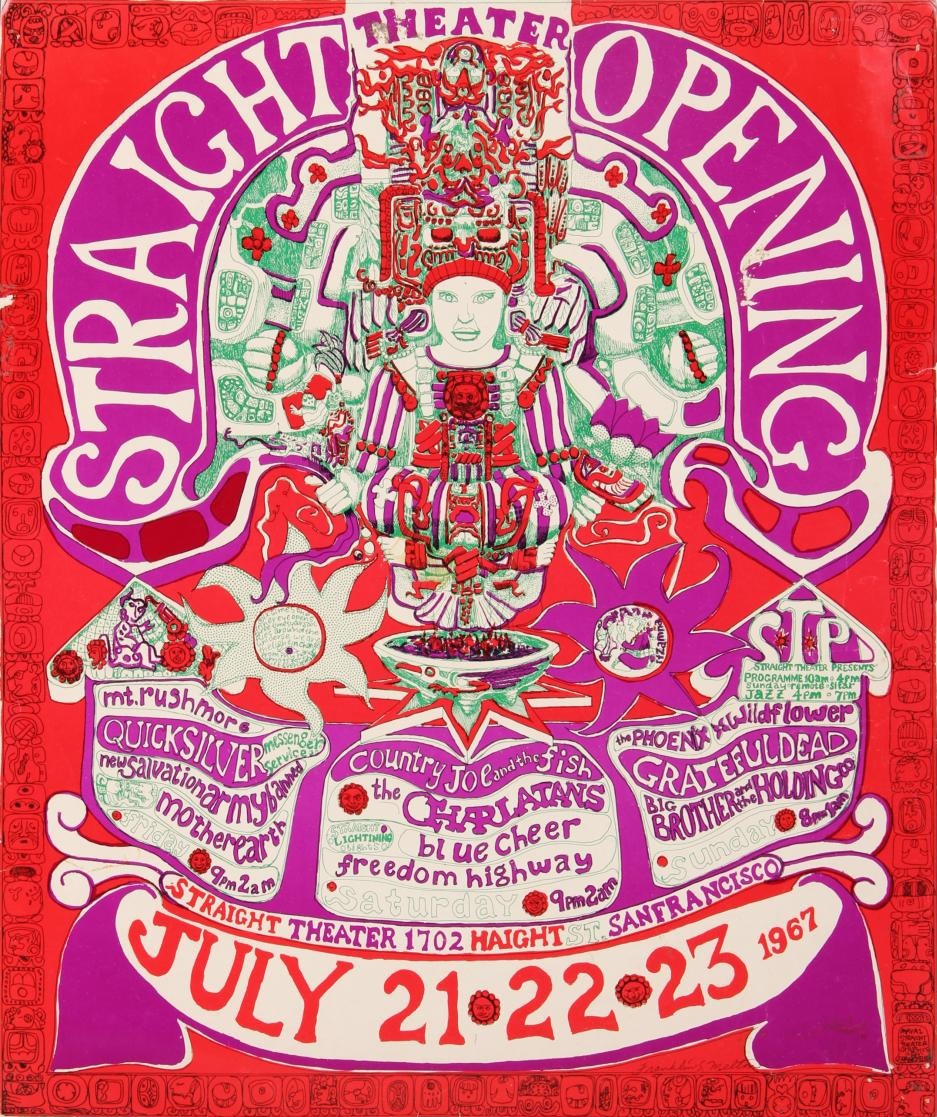
AOR-2.220 · Frank Melton
San Francisco
Big Brother and the Holding Company
Wildflower
Phoenix
Neal Cassady's voice, whatever it actually sounded like that night, has been reduced to a fragment — a scrap of tape pressed onto a flexi-disc in the back of a book. That's about the shape of what survives from Sunday, July 23, 1967, when the Grateful Dead and Big Brother and the Holding Company closed out the grand-opening weekend of the Straight Theater on Haight Street.
The Straight was a neighborhood project before it was a venue. A former movie house, it had been converted by people in the Haight into a ballroom of their own — not a Bill Graham operation, not a Family Dog room, but something the community wired together itself. The grand opening ran three nights, and there's a single poster that lists the whole thing. Frank Melton is credited as the designer, and the piece carries the catalog number AOR-2.220. The number and the Melton attribution show up consistently across dealer listings, and the definitive Art-of-Rock catalog record on classicposters.com confirms both: AOR-2.220, Frank Melton, Straight Theater, July 21-23, 1967. So this one is settled — catalog number and designer are primary-confirmed.
The poster lays out the run across the weekend. Friday, July 21: Quicksilver Messenger Service and Mount Rushmore, with the New Salvation Army Banned and Mother Earth. Saturday, July 22: Country Joe and the Fish, alongside the Charlatans, Blue Cheer, and Freedom Highway. And Sunday, July 23 — the night this page is about — the Grateful Dead and Big Brother and the Holding Company, with Janis Joplin fronting Big Brother, plus Wildflower and Phoenix filling out the bill (the Sunday lineup confirmed on dead.net and jerrybase, the weekend's shape on the chickenonaunicycle show list). One sheet, three nights, the whole opening weekend printed together.
Here's where the honesty has to do its work. No full setlist survives for July 23. I'm not going to build one out of guesswork, and I'd be suspicious of anyone who handed you a tidy song-by-song account of this particular night. What we do have is tape. Two independent recordings of 7/23/67 circulate — a soundboard and an audience recording — and you can find them collected on the Internet Archive under the identifier gd1967-07-23. That's the anchor: not a memory, not a poster caption, but actual sound. jerrybase logs the date (19670723) and dead.net keeps a page for it (/show/july-23-1967), and the tapes are the reason those entries aren't just placeholders.
The detail that keeps this night from being just another 1967 Dead show is Neal Cassady. Cassady — the Beat wheelman, Kerouac's Dean Moriarty, by 1967 a fixture in the Dead's orbit — did a spoken-word rap over the band's jam that night, riding his stream-of-consciousness patter on top of whatever the Dead were doing. A fragment of that later surfaced on a flexi-disc ("Neal Cassady Raps," an Eva-Tone soundsheet) bound into the first edition of Hank Harrison's *The Dead Book* in 1973. That's the provenance chain, and it's worth stating plainly: the rap happened, a piece of it was captured, and it reached the public years afterward as a flimsy plastic record tucked into a book rather than as anything you'd call a release. (One wrinkle to flag, since it trips people up: the disc's own text dates the recording to "September 1967," but the grand-opening night the rap comes from was this one, July 23 — so the artifact mislabels itself.) Cassady would be dead within seven months, in February 1968, which gives the surviving scrap a weight it couldn't have carried at the time.
What I can't tell you is how the whole thing actually played — how long the jam ran, where Cassady came in, what the Dead were building under him, how the room took it. The record is thin. The tapes exist and the pieces are documented (hooterollin and gratefuldeadoftheday both keep the night in view), but the experience of being in that converted movie house on a Sunday in July, with Janis Joplin somewhere on the same bill and Cassady talking over the band, is mostly gone. What's left is a poster, two tapes, and a fragment.
The same calendar date lands differently in the years on either side. In 1965 there's nothing to mark — the scene didn't exist yet; the Family Dog wouldn't throw its first dance until October of that year. By 1968, July 23 was a Tuesday and Bill Graham's Fillmore West opened a run with Moby Grape, the Jeff Beck Group, and Mint Tattoo, on a Lee Conklin poster catalogued BG-130. A year further on, July 23, 1969 was a Wednesday, and the Fillmore West had Ten Years After, Ike and Tina Turner, and The Flock, with a David Singer poster, BG-183. Those are the well-machined Graham productions — house venue, house artist, clean catalog numbers.
The Straight Theater sits apart from that lineage, and that's most of why it matters. It was the neighborhood's own room, opened by the people who lived around it, and the record it left behind is appropriately homemade: a single grand-opening poster, a couple of tapes passed hand to hand, and Neal Cassady's voice reduced to a flexi-disc fragment in the back of a book. Not a triumph, not a legend — just a Sunday night on Haight Street that a few people thought to keep.
Verification Notes
ANTAGONIST-CHECKED (2026-07-20). VERIFIED: 1967-07-23=Sunday; Straight Theater grand-opening weekend 3rd night, GD + Big Brother (Janis Joplin), Wildflower/Phoenix support (dead.net /show/july-23-1967 + jerrybase 19670723 + two circulating tapes, IA gd1967-07-23). CORRECTED: draft's Fri/Sat support lineups were mis-assigned — Mother Earth was on Fri 7/21 (w/ QMS/Mount Rushmore/New Salvation Army Banned), Sat 7/22 was Country Joe + Charlatans/Blue Cheer/Freedom Highway (chickenonaunicycle); prose fixed. Neal Cassady spoken-word over the jam; fragment on The Dead Book flexi (1973) — note the flexi mislabels itself 'September 1967'. HONEST GAP: catalog AOR-2.220 + Frank Melton attribution dealer-corroborated but NOT confirmable headless (classicposters browser-only; NOT on Wolfgang's) — number hedged in prose, poster row carries no image. No setlist survives — none fabricated.
Were You There?
Do you have memories of this show, or an original AOR-2.220 poster? On This Day in Art Rock History celebrates the people who lived through the psychedelic era. Your stories and collections matter to this archive.
Comments