

The Beard
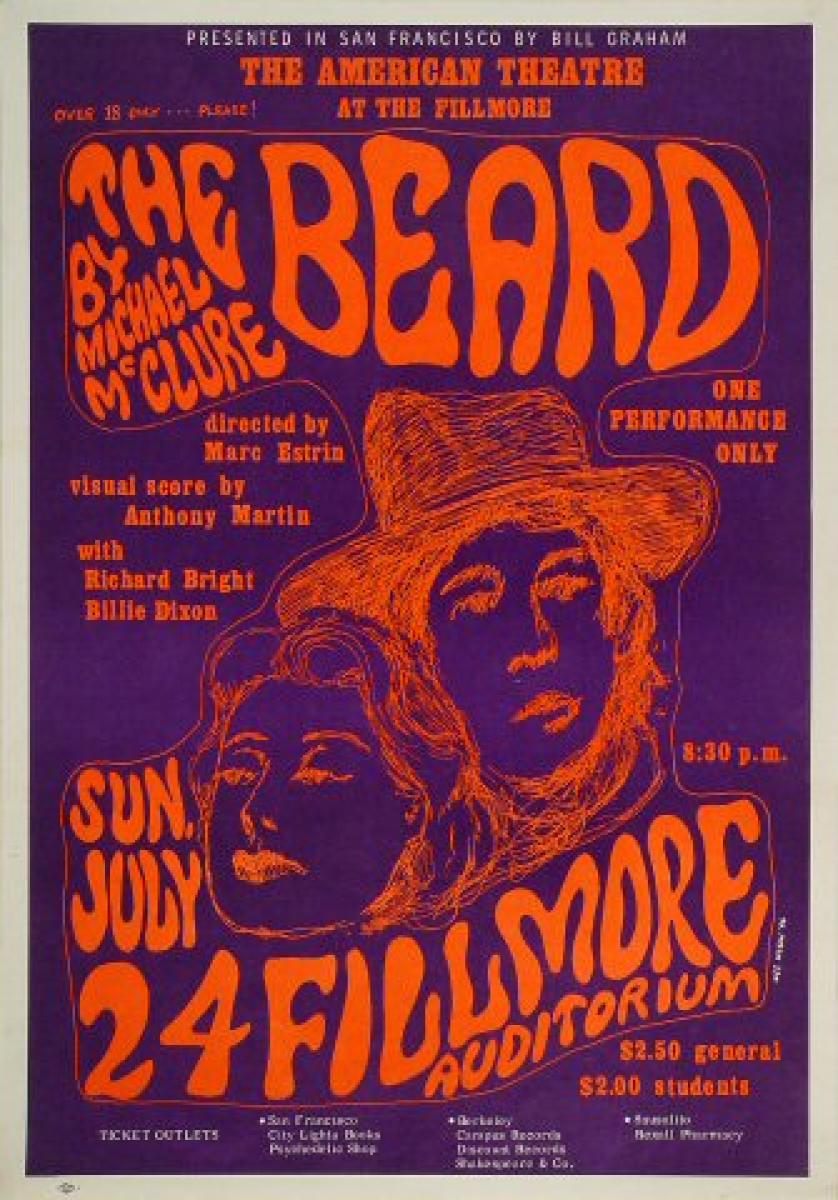
BG-19 · Wes Wilson
San Francisco
Sundays at the Fillmore Auditorium usually meant music. On July 24, 1966, it meant a play — and, as it turned out, a play the San Francisco police did not intend to let happen twice.
The event was a single performance of "The Beard," Michael McClure's two-character piece that puts Jean Harlow and Billy the Kid in a blue-lit eternity and lets them circle, taunt, and finally consume each other. Bill Graham presented it; the program credited "The American Theatre." The poster is BG-19, art by Wes Wilson, who gave the bill facing portraits of Harlow and the Kid — the platinum movie star and the frontier outlaw, two American myths staged against each other. That pairing is the play in miniature, and it is worth pausing on the fact that this is the artifact the day hangs on. There is no concert here. The chronicle treats the poster-anchored night as a real day anyway, and on this evidence it earns the standing: a Wes Wilson piece, a Graham presentation, a Fillmore date. The form is the same as any dance-concert bill from that room. What's on the wall is a play.
McClure was a Beat — one of the poets who read at the Six Gallery in 1955, the night Ginsberg first delivered "Howl" — and "The Beard" carried the Beat instinct for confrontation straight into its language and its staging. The piece ends in a simulated sex act, and its dialogue is deliberately obscene. That was the point, and it was also the problem. According to McClure's own account (warholstars.org), a second performance had been planned, and it was cancelled after the police warned Graham directly: put the play on again and they would bust him and pull the Fillmore's license. Graham, a year before the Summer of Love would make his hall a landmark, was caught between the avant-garde he was willing to book and the vice squad that policed it. He backed off the second show.
I want to be careful about the legal specifics, because the sources here support a fairly narrow claim. What is confirmed is the shape of it: a single Fillmore performance on July 24 (the play had premiered earlier, in December 1965, at the Actors' Workshop — so this was the first Graham/public staging in that room, not the play's world premiere), a police warning tied to obscenity — the language and the simulated act — and the cancellation of the planned second show rather than a raid on the Fillmore itself. Wolfgangs.com anchors the date, venue, and Wilson's authorship of BG-19; warholstars.org carries McClure on the cancellation; recordmecca.com and illustractiongallery.com corroborate the poster and the episode, and the Wikipedia entry on McClure lines up with the same outline. What none of those establish, and what I won't claim, is a fuller courtroom drama at the Fillmore. The Fillmore's part of the story is the warning and the retreat.
The arrests came later, and somewhere else. "The Beard" moved to The Committee, the satirical theater in North Beach, and it was there — on August 8, 1966, by the accounts above — that the actors were arrested for obscenity. That is the more familiar node in the play's history; "The Beard" would go on to become a genuine free-speech cause, dogged by arrests in other cities. But the arrests belong to The Committee and the dates after. What belongs to July 24 and to the Fillmore is the collision before the collision: the moment the room that would soon define San Francisco rock briefly held the Beats and the law in the same frame, and the promoter blinked.
It is tempting to make Graham the villain or the hero of that moment, and the honest answer is that the record here supports neither. He presented the play. He was warned. He canceled the second night. A license is a concrete thing for a man building a business on a single hall, and there is no source in front of me that tells us what he felt about McClure's script or about the ultimatum. The gap between presenting the avant-garde and protecting the venue is real, and this Sunday sits squarely in it — but I'd be inventing if I filled that gap with motive.
What can be said plainly is that this date is the 1966 night's alone. The other July 24s around it are quiet. 1965 is before the ballroom scene had cohered into the thing we now name. In 1967 the date fell on a Monday, in 1968 a Wednesday, in 1969 a Thursday, and no anchored San Francisco show for any of those surfaced in the research. So there is no competition for the day and no need to manufacture any. July 24 in this chronicle is a theatrical night — a Beat play, a Wilson poster, a warning from the police, and a second performance that never happened.
That last absence is the part worth holding onto. The poster for BG-19 advertises one performance, and one performance is all San Francisco got. The art on the wall promised Harlow and Billy the Kid; the week delivered them once and then, under pressure, not again. For a scene that would spend the next year insisting on its own freedom, it's a useful reminder that in the summer of 1966 the freedom was still provisional — granted for a night, withdrawn by a phone call, and carried across town to North Beach, where the arrests were waiting.
Verification Notes
ANTAGONIST-CHECKED. VERIFIED: 1966-07-24=Sunday; a THEATRICAL night — Bill Graham presented Michael McClure's play 'The Beard' at the Fillmore Aud; BG-19 by Wes Wilson (Wolfgang's BG019 confirms date/venue/artist headless). 2nd planned performance cancelled after SFPD warning; play moved to The Committee, actors arrested for obscenity Aug 8 1966 — corroborated across warholstars.org (McClure) + Wikipedia + BCCLA case history (candidates written back). VENUE CORRECTION: pre-seed row had venue_id=1 (Carnegie Hall) — fixed to 27 (Fillmore Aud). Non-concert; classified type=news.
Were You There?
Do you have memories of this show, or an original BG-19 poster? On This Day in Art Rock History celebrates the people who lived through the psychedelic era. Your stories and collections matter to this archive.
Comments