

Hollow TV
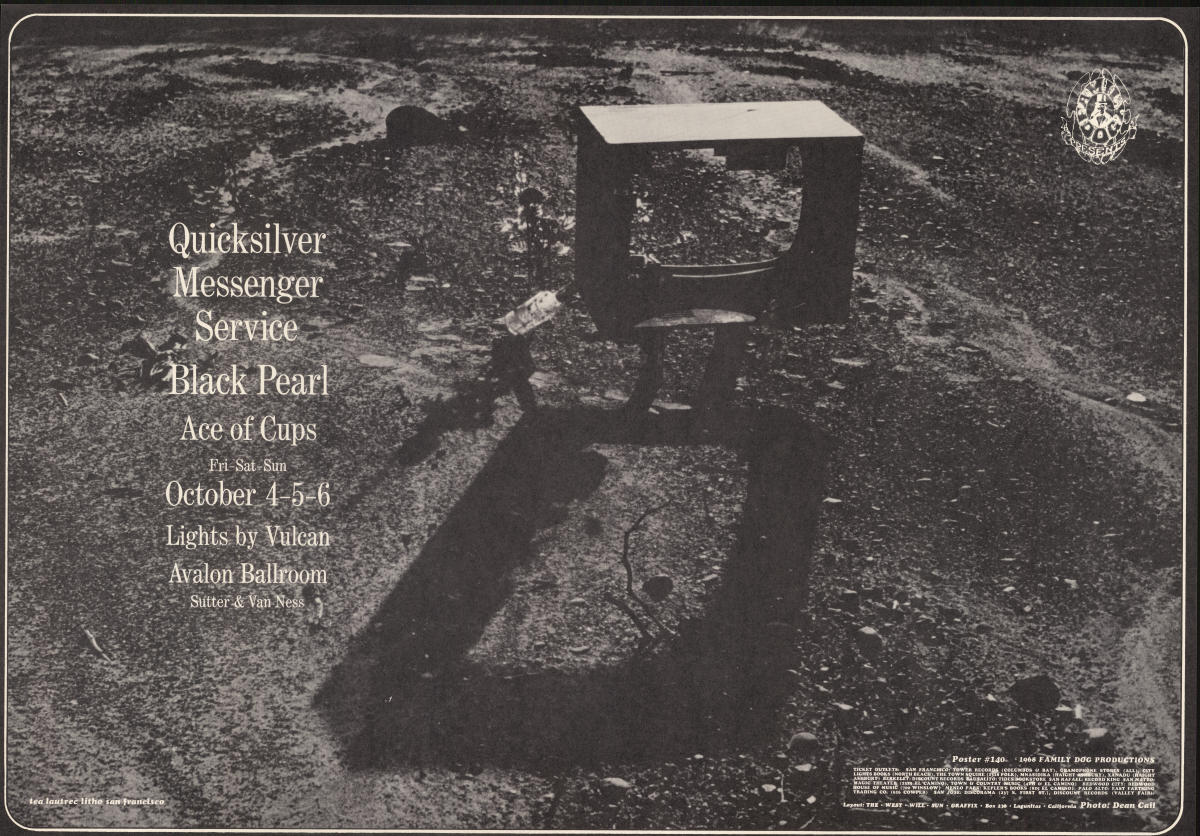
FD-140 · Wes Wilson
San Francisco
Black Pearl
Ace of Cups
On Friday, October 4, 1968, the Avalon Ballroom gave over its weekend to the band that, more than any other, was the house's own: Quicksilver Messenger Service, playing a three-night stand through Sunday the 6th with Black Pearl and the all-woman Ace of Cups beneath them on the bill (per chickenonaunicycle's Family Dog list, the Smithsonian American Art Museum, and the CGC-graded Concert Poster Gallery lot, which all give the October 4-6 dates and the catalog number FD-140).
By the autumn of 1968 Quicksilver were no longer the promising unknowns of the Charlatans-and-Family-Dog dawn. They had a debut album out on Capitol, a reputation built on Gary Duncan and John Cipollina's twin-guitar conversations, and enough Avalon nights behind them that an Avalon marquee with their name on it read less like an announcement than a homecoming. This was Family Dog's room and Chet Helms's operation, and Quicksilver were the kind of band Helms could hang a whole weekend on without a bigger name needed above them.
Black Pearl, the direct support, were a harder-edged outfit then orbiting the Boston-to-San-Francisco circuit — a horn-and-guitar band whose self-titled Atlantic record landed around this same stretch. Ace of Cups opened: five women from San Francisco who had been a fixture of the ballroom scene for two years, admired by the musicians around them (Jimi Hendrix among the admirers on record) far more than the record industry ever rewarded them, since they would not cut a proper album until decades later. Their presence on an FD poster is itself a small piece of the scene's texture worth keeping — a reminder that the Avalon bill was not only the names that later got the box sets.
The poster is where this date earns its place on the calendar. It carries catalog number FD-140 and the designer credit goes to Wes Wilson — the man whose melting, fire-lettered Fillmore and Avalon posters had done as much as anyone's to invent the visual language of the whole era. But FD-140 is a conspicuous departure from the Wilson everyone pictures. Instead of the swelling, barely-legible letterforms, the sheet is built around a stark black-and-white photograph by Dean Cail: a monolithic form throwing a long shadow across what reads as a bare, lunar plain — closer to a science-fiction still than a dance-hall handbill. Collectors and the Smithsonian alike have given the image the nickname "Hollow TV." It was printed by Tea Lautrec Litho and published by Family Dog Productions, and the Smithsonian American Art Museum holds a copy (object 2007.27.31, a 2007 gift from Sidney Lawrence III). That a poster this plainly photographic still ran under Wilson's name is a useful corrective to the idea that the SF poster artists each had one fixed style; by late 1968 the form was loosening, and FD-140 is a clean example of it.
A word on where this sits in the Family Dog run, because the numbers around it are easy to trip over. FD-139 is the weekend before — Flatt and Scruggs with the Sons of Champlin, September 27-29 — and FD-141 is the weekend after, the Grateful Dead with Lee Michaels and Mance Lipscomb on October 11-13. FD-140 is the October 4-6 Quicksilver weekend, squarely between them, and the catalog sequence corroborates the date rather than complicating it.
The antagonist pass turned up nothing that moves the hero. October 4, 1968 was in fact a Friday, which makes the three-night Friday-Saturday-Sunday run the standard Avalon shape, not an anomaly. The designer attribution is uniform across every reachable source — chickenonaunicycle, the Smithsonian, the Victoria & Albert, and the auction record all say Wes Wilson, and no source anywhere floats Mouse or Kelley for this sheet. The only thing a careful reader should hold loosely is the exact support billing: the Smithsonian's title truncates to "Quicksilver Messenger Service, Black Pearl..." and drops Ace of Cups, but two independent reachable sources (COAU and the Concert Poster Gallery lot) carry all three acts, so the full bill stands. We make no claim about what anyone played — no setlist is sourced, and none is invented here.
What the day gives the chronicle, finally, is a double image: the most Avalon of bands on the most Avalon of weekends, under a poster that quietly argues the ballroom scene was already outgrowing the look that made it famous (per chickenonaunicycle's Family Dog list, the Smithsonian American Art Museum, and the Concert Poster Gallery, which together fix the bill, the date, the catalog, and the designer).
Verification Notes
ANTAGONIST VERIFIED (check-claims ok: chickenonaunicycle + wolfgangs; also Smithsonian American Art Museum 2007.27.31, Concert Poster Gallery CGC lot 5348, V&A). Quicksilver Messenger Service / Black Pearl / Ace of Cups, Avalon, Oct 4-6 1968 (Fri-Sun). Designer Wes Wilson; central image a DEAN CAIL PHOTOGRAPH (atypical for Wilson -- no trademark lettering), printed Tea Lautrec Litho, pub. Family Dog. Oct 4 1968 = Friday (verified). Catalog FD-140 between FD-139 (Sep 27-29) and FD-141 (Oct 11-13) -- no off-by-one. Ace of Cups truncated off the SAAM title but confirmed by COAU + Concert Poster Gallery.
Were You There?
Do you have memories of this show, or an original FD-140 poster? On This Day in Art Rock History celebrates the people who lived through the psychedelic era. Your stories and collections matter to this archive.
Comments