

Youngbloods / It's a Beautiful Day / Initial Shock (night 2)
FD-135 · Roger Weil
San Francisco
It's a Beautiful Day
Initial Shock
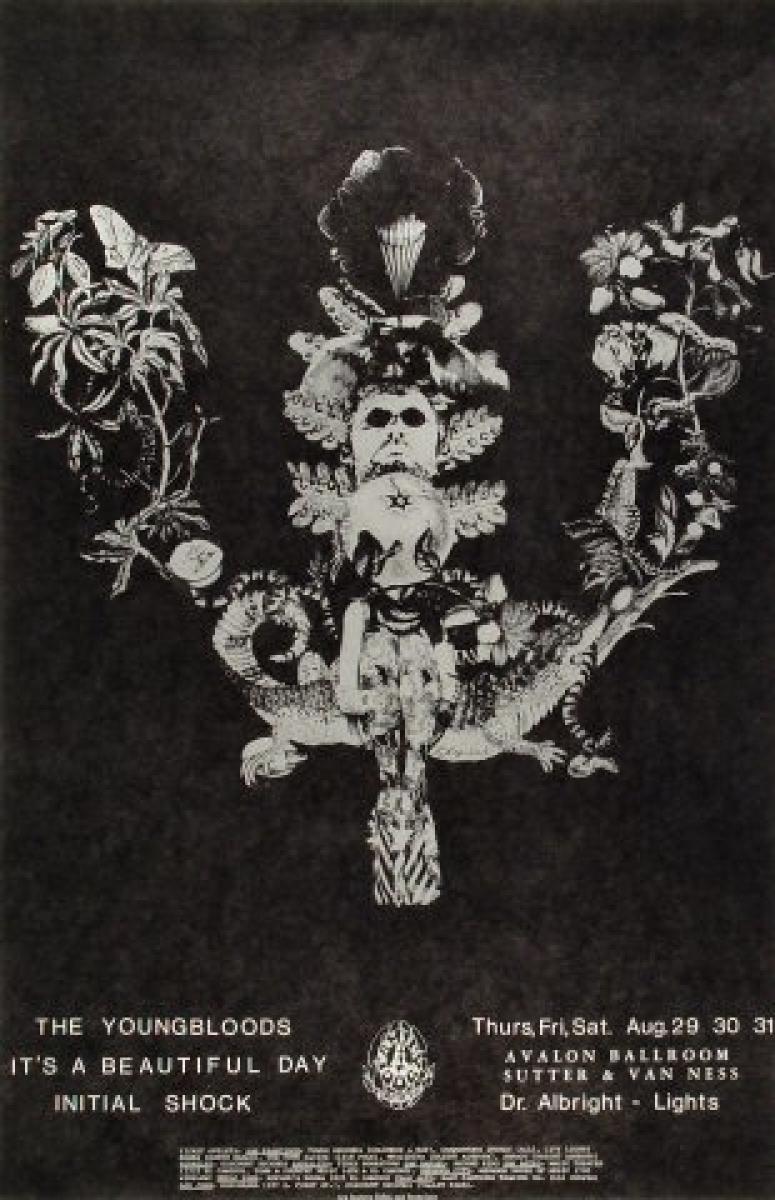
Roger Weil's poster for the Avalon that weekend is a strange, beautiful thing: white on black, drawn in the dense hatched manner of an old engraving, a masked figure crowned in feathers and flanked by two branching sprays of botanical illustration, riding what appears to be a lizard. It reads like a plate torn out of a Victorian natural-history volume and put through a fever. The type at the bottom is plain and unpsychedelic, almost polite by 1968 Avalon standards: THE YOUNGBLOODS / IT'S A BEAUTIFUL DAY / INITIAL SHOCK — Thursday, Friday, Saturday, August 29, 30 and 31, Avalon Ballroom, Sutter and Van Ness, with Dr. Albright on lights.
Friday, August 30, 1968 was night two.
The Youngbloods had come west. Jesse Colin Young's band had formed in the East, cut "Get Together" in 1967 — a song that did modestly on release and would become an anthem two years later when a public-service campaign put it back on the radio — and then moved to Marin County, where they turned into a California band. By the late summer of 1968 they were a regular Avalon draw rather than visitors.
Second-billed were It's A Beautiful Day, who were then very much a San Francisco act in the making: David LaFlamme's violin-fronted group, still a year out from the debut album with the white bird on the cover and "White Bird" inside it. Initial Shock opened. The Family Dog's Avalon had always been the more communal of the two big halls — Chet Helms ran it closer to a dance than a concert — and a bill like this one, a transplanted East Coast band, a local group on the way up, and an opener, is the Avalon in its ordinary working state rather than on one of its famous nights.
The lights were Dr. Albright's, credited in the same plain type as the bands. The Avalon's light shows were a fixture of the room rather than an accessory to it — liquid projections on the wall behind the stage, worked live by an operator with clock glasses and dyes, and the Family Dog credited them on the poster the way it credited the acts. It is a small piece of evidence about what these rooms thought they were selling: not a concert with decoration, but an evening in which the band, the light show and the poster were three parts of the same production.
That is part of why it belongs here. Across town the same evening, Bill Graham's Fillmore West was turning over its own week: the Grateful Dead had taken over the back half of Lee Conklin's lion poster the night before, playing with the Preservation Hall Jazz Band and the Sons of Champlin. Two houses, four blocks apart, both running three-band bills, both on their second night — and only one of them is the show anyone tells stories about.
The Avalon's poster for that unremarkable Friday is the one that survives as art. Weil is not a name that comes up with Wilson, Moscoso, Mouse and Kelley; the Family Dog series ran to hundreds of sheets and most of its designers are remembered by catalog number rather than by name. FD-135 is a reminder that the standard held anyway — that a routine three-band weekend at Sutter and Van Ness still got a poster somebody took seriously.
Verification Notes
ANTAGONIST-CHECKED. Night 2 of the FD-135 run (COAU: 'August 29-31, 1968 ... Youngbloods, It's A Beautiful Day, Initial Shock / FD-135 / Roger Weil'). POSTER ART confirms bill, dates and venue verbatim: 'THE YOUNGBLOODS / IT'S A BEAUTIFUL DAY / INITIAL SHOCK Thurs,Fri,Sat. Aug.29 30 31 AVALON BALLROOM SUTTER & VAN NESS Dr. Albright - Lights'. HERO of 08-30 -- REASSIGNED from BG-80 to satisfy the SOP's one-poster-one-hero rule (BG-80 had heroed four consecutive days in the salvaged daymap). NEW ARTIST: Roger Weil (not previously in the artists table) -- profile required, see add_profiles script. CANONICAL NAME: linked to 'It's a Beautiful Day' id 141 (higher usage) NOT the duplicate id 325 -- merge is a human call.
Were You There?
Do you have memories of this show, or an original FD-135 poster? On This Day in Art Rock History celebrates the people who lived through the psychedelic era. Your stories and collections matter to this archive.
Comments