

Creedence Clearwater Revival (BG-133)
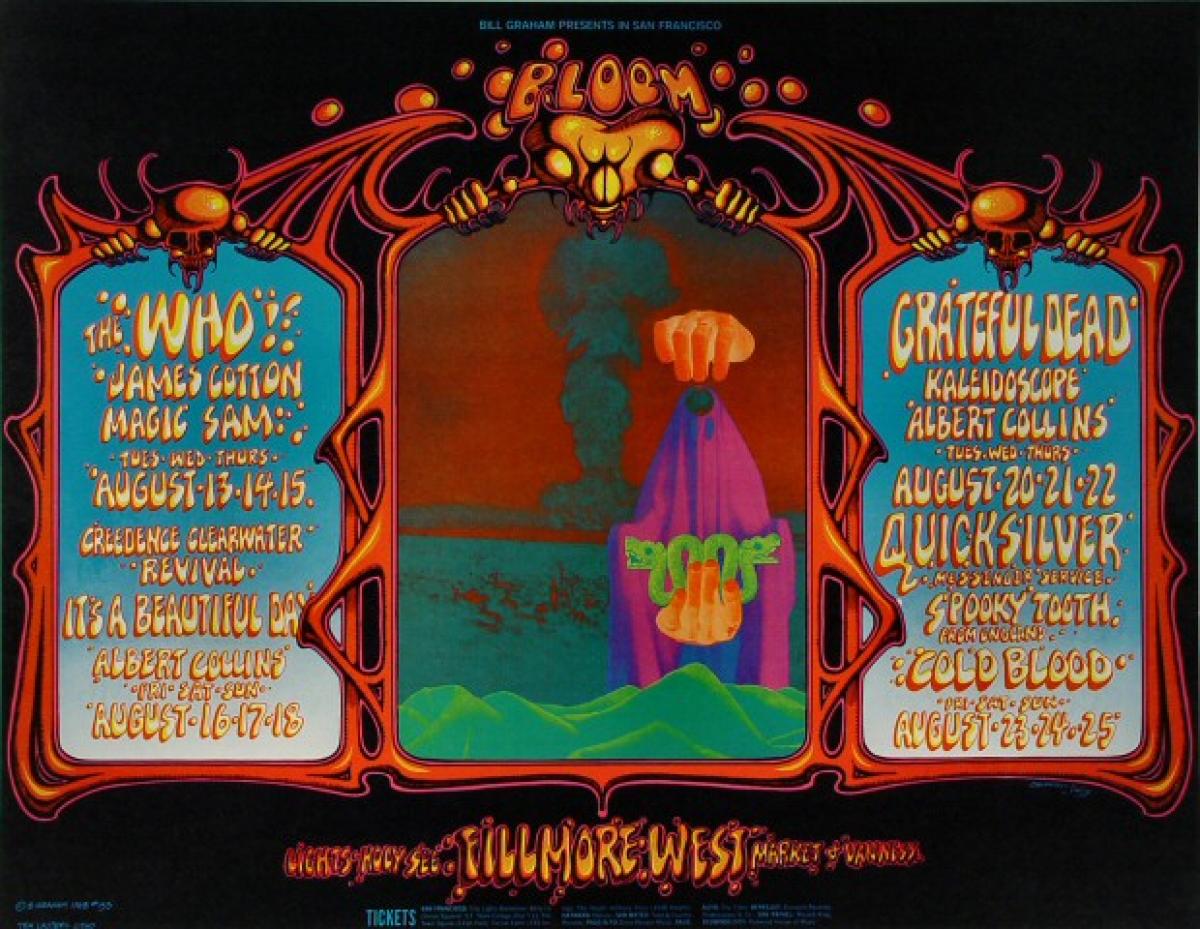
BG-133 · Alton Kelley, Rick Griffin
San Francisco
It's a Beautiful Day
Albert Collins
Friday, August 16, 1968 is the San Francisco ballroom scene's rival-twins pattern in its purest form. Across town from each other, the two great rooms opened weekend stands the same night. At Fillmore West, the second bracket of BG-133 began: Creedence Clearwater Revival — months from "Proud Mary," still a Bay Area band on the cusp — over It's a Beautiful Day and the Texas blues of Albert Collins (the bill order per the Bill Graham Foundation's Aug-16 page, which files all three under BG-133). At the Avalon, Chet Helms's Family Dog answered with FD-133: Bill Haley and the Comets — the man who'd put "Rock Around the Clock" into the world fourteen years earlier — with the Drifters and the young Flamin' Groovies beneath him, the poster by Jerry Wainwright and George Hunter with Vulcan Lights (per wolfgangs, which credits both artists and brackets the run Aug 16–18). One room bet on the scene's future; the other, on its roots — the same Friday night, a mile apart.
A year later, on Saturday, August 16, 1969, the second day of Woodstock belonged substantially to San Francisco. Santana — barely recorded, about to be made by this one afternoon — played a little after two; the Grateful Dead took the stage late that night; and Creedence, a year on from that Fillmore West bracket above, followed after midnight (performance times per the Woodstock festival record on wikipedia, corroborated against setlist.fm). The bands the ballrooms had built were, that day, the festival's spine.
The 1968 half of this date deserves unpacking, because Creedence Clearwater Revival at Fillmore West that August is a band caught in the last weeks before everything changed for them.
They were from El Cerrito, across the bay — John and Tom Fogerty, Stu Cook and Doug Clifford, who had been playing together since junior high as the Blue Velvets and then, under a name their label imposed, the Golliwogs. They had renamed themselves Creedence Clearwater Revival in 1967 and released their first album in July 1968, weeks before this show. "Suzie Q" was on the radio. "Proud Mary" was five months away, and after it came the run of singles — "Bad Moon Rising," "Green River," "Fortunate Son" — that made them, briefly, the biggest band in America.
So on this Friday they were a local group on a Bill Graham bill, second-billed considerations aside, and it is genuinely the last moment at which that description fits. It's a Beautiful Day, beneath them, were also a year from their moment; Albert Collins, the Texas guitarist billed third, was the roots act on the card, in the same position Bukka White and Bo Diddley occupy on Avalon bills throughout this chronicle.
Across town the Family Dog answered with FD-133, and the contrast between the two rooms that night is almost too neat to be true. Chet Helms had booked **Bill Haley and the Comets** — the man who had put "Rock Around the Clock" into the world fourteen years earlier — with the Drifters and the young Flamin' Groovies underneath. One hall bet its Friday on a band five months from national fame; the other bet on the man who had started the whole thing in 1954. Both bets were characteristic. Jerry Wainwright and George Hunter drew the Avalon sheet, with Vulcan Lights.
A year later the same calendar date belonged to a field in New York. Saturday, August 16, 1969 was Woodstock's second day, and San Francisco supplied much of its spine: Santana played early in the afternoon, barely recorded and about to be made by the appearance; the Grateful Dead played late that night in the rain and by most accounts badly; and Creedence — a year on from the Fillmore West bracket above, now genuinely enormous — followed after midnight, going on so late that their set was left out of the film and the album. Fogerty's stated frustration about following the Dead into a sleeping crowd is part of why.
That is the through-line worth holding: the bands the ballrooms built in 1966, 1967 and 1968 became, by the summer of 1969, the acts a half-million people had come to a farm to see. This chronicle mostly documents the rooms. Woodstock is what the rooms produced.
Verification Notes
Antagonist (2026-08-10 headless run): corroboration via check-claims on vetted sources. BG-133 Aug 16-18 leg = CCR/It's a Beautiful Day/Albert Collins. VERIFIED billgrahamfoundation Aug-16 page (Act1/2/3). DEEPENED 2026-09-01 (G4). Bill verified vs COAU Fillmore West 16 August 1968: 'Creedence Clearwater Revival, It's A Beautiful Day, Albert Collins Lights: Holy See'.
Were You There?
Do you have memories of this show, or an original BG-133 poster? On This Day in Art Rock History celebrates the people who lived through the psychedelic era. Your stories and collections matter to this archive.
Comments