

Chuck Berry (BG-187)
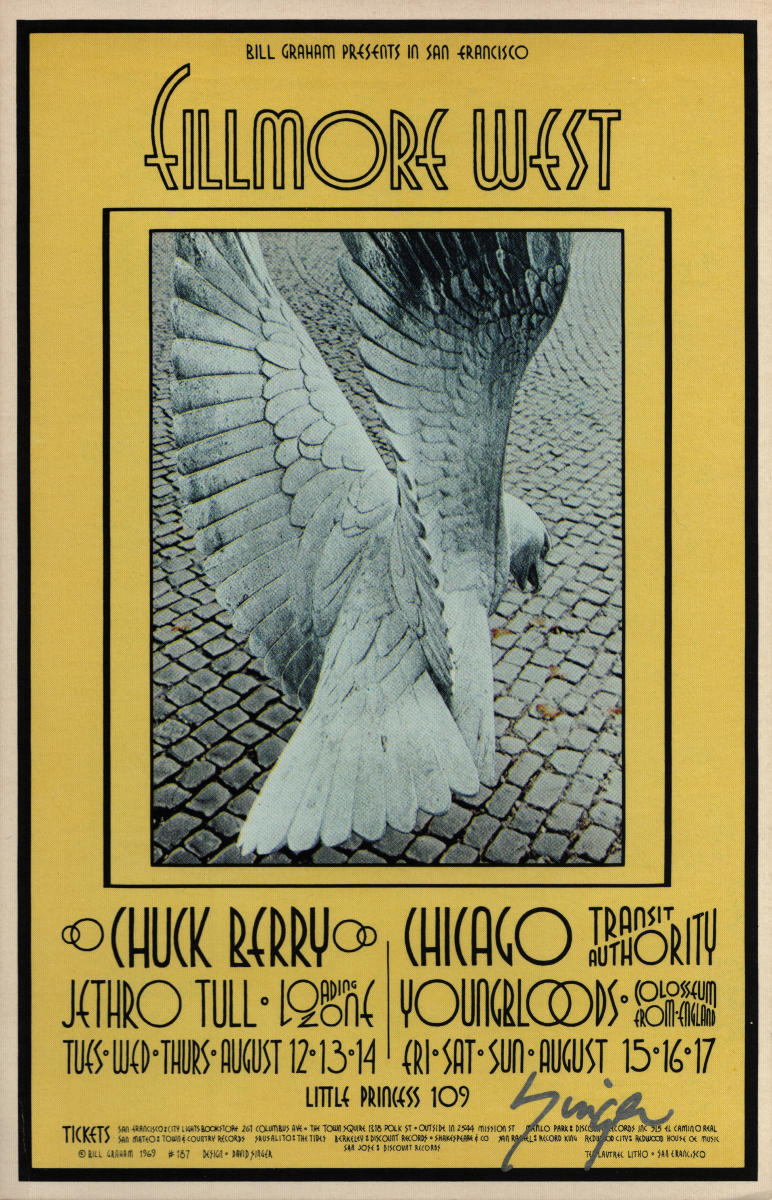
BG-187 · David Singer
San Francisco
Jethro Tull
Loading Zone
August 14 catches two very different Fillmore West nights a year apart, and the pairing is almost too neat: in 1968 the future of rock volume (The Who, second of three nights under BG-133, with James Cotton and Magic Sam again below them — per billgrahamfoundation and thewho.com); in 1969, its founding father. For the week of Aug 12–17, 1969, David Singer's BG-187 poster (per famsf and wolfgangs, which credit Singer and list the full bill) put Chuck Berry at the top of a split-billed card — Berry, Jethro Tull, and The Loading Zone on the early nights, Chicago Transit Authority, the Youngbloods, and Colosseum on the later ones. Wolfgang's describes BG-187 explicitly as a "split-billing poster"; the exact per-night division (Berry's trio on Aug 12–14, the CTA trio on Aug 15–17) rests on a single archival reading and should be treated as likely rather than settled. On Thursday the 14th, Berry — duckwalking through the room that psychedelia built, a decade after "Maybellene" — headlined the older, plainer rock-and-roll the ballroom kids had descended from.
That the 14th of August could hold The Who in one year and Chuck Berry the next, in the same room, is the whole compression of the era in a single date on the wall.
(One contested detail carried for the human gate: a lone community listing says Jethro Tull cancelled the Aug 13 night; it is uncorroborated and is NOT asserted here.)
Chuck Berry at Fillmore West in August 1969 is a booking with a particular weight to it, and it is worth slowing down on why.
Berry was forty-two. "Maybellene" was fourteen years behind him, "Johnny B. Goode" eleven. In between he had served twenty months in federal prison on a Mann Act conviction that most accounts treat as racially motivated prosecution, and had come out in 1963 to find British bands selling his songs back to America. By 1969 he toured constantly, usually alone, hiring local backing bands in each city and expecting them to know the material — which they invariably did, because his songs were the common vocabulary every bar band in the country had learned first.
So the Fillmore West audience watching him in 1969 was watching the source. The guitar introduction to "Johnny B. Goode" is the opening move of most of the music that room had been built for. Graham understood this and booked him repeatedly: here, at the Fillmore West's fall-series opener in September 1968, and again elsewhere in these pages.
Jethro Tull, second-billed, were on their first substantial American tour, months past *This Was* and with Ian Anderson's flute-and-one-leg stage presence already fully formed. The Loading Zone, third, were the Oakland band with Linda Tillery singing — one of the East Bay groups Graham used steadily and whom history has largely mislaid.
David Singer's BG-187 is a split-billing sheet, and this chronicle marks the division as likely rather than settled: the Berry / Tull / Loading Zone bracket on August 12–14, and Chicago Transit Authority with the Youngbloods and Colosseum on August 15–17. Wolfgang's describes the poster explicitly as split-billed; the exact per-night boundary rests on a single archival reading, so it is recorded as probable and not asserted as fact.
A year earlier, this same date at this same address held something quite different: the second of three nights of the Who under BG-133, with James Cotton and Magic Sam beneath them. That the 14th of August could hold the Who in 1968 and Chuck Berry in 1969, in one room, is the compression of the whole era into a single square on the calendar — the music's origin and its loudest descendant, one year apart, same stage.
(One contested detail carried for the record rather than asserted: a lone community listing says Jethro Tull cancelled the August 13 night. It is uncorroborated and is not stated here as fact.)
Verification Notes
Antagonist (2026-08-10 headless run): corroboration via check-claims on vetted sources. BG-187 = Fillmore West Aug 12-17 1969, David Singer, split-billing poster. VERIFIED famsf+wolfgangs+Heritage+RR. Per-night split (Berry trio Aug 12-14) FLAGGED single-source (FAMSF); Jethro Tull Aug-13 cancellation UNABLE-TO-CONFIRM (community-only) — not asserted. DEEPENED 2026-09-01 (G4). Bill verified vs COAU Fillmore West 14 August 1969: 'Chuck Berry, Jethro Tull, Loading Zone Lights: Little Princess #109'. The BG-187 split-bill boundary remains recorded as PROBABLE, not settled, and the uncorroborated Jethro Tull cancellation claim is still not asserted.
Were You There?
Do you have memories of this show, or an original BG-187 poster? On This Day in Art Rock History celebrates the people who lived through the psychedelic era. Your stories and collections matter to this archive.
Comments