Muddy Waters / Buffalo Springfield / Richie Havens (opening)
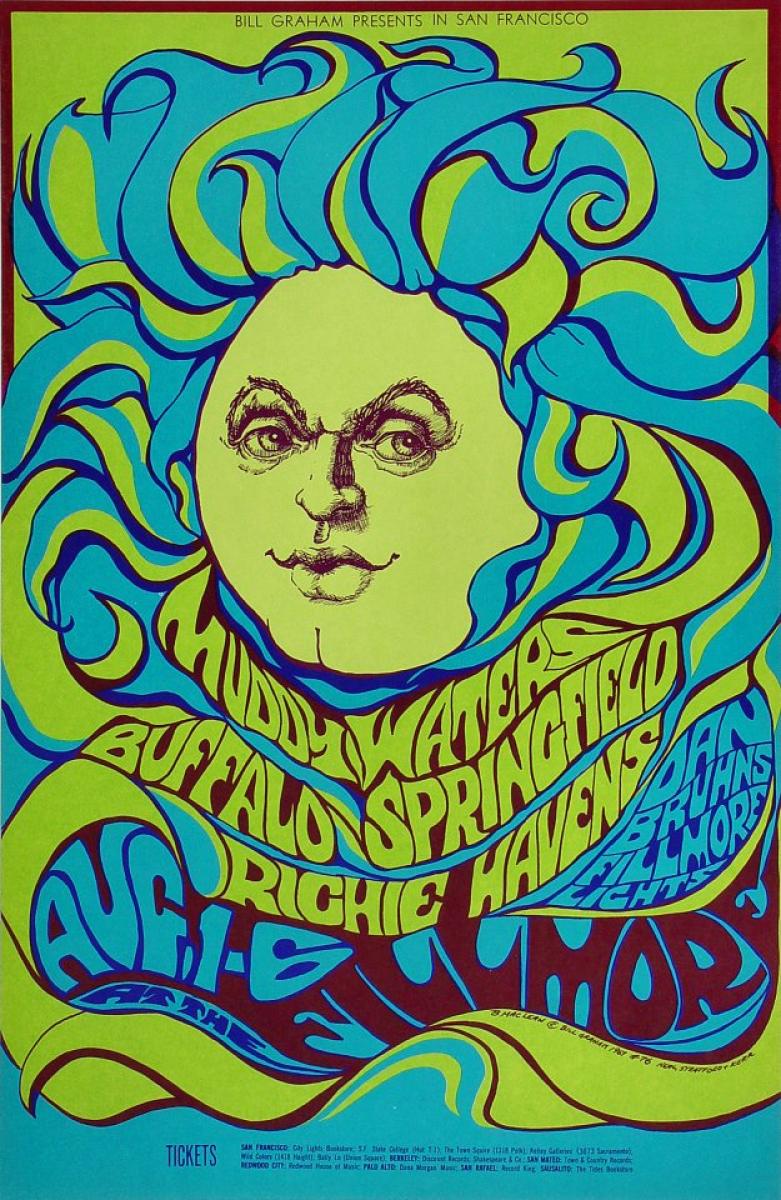
BG-76 · Bonnie MacLean
San Francisco
Buffalo Springfield
Richie Havens
August 1 gives us two very different kinds of history on the same calendar day, two years apart, and the chronicle is better for holding both. The first is a poster and a bill; the second is a picket line.
On Tuesday, August 1, 1967, Bill Graham opened a six-night stand at the Fillmore Auditorium with Muddy Waters headlining, Buffalo Springfield second, and Richie Havens opening — Dan Bruhns' Fillmore Lights behind them. The run held the same bill straight through, August 1 to 6, and it is unusually well documented: chickenonaunicycle lists all six nights with the identical trio and the "DBFL" lights credit, the Fine Arts Museums of San Francisco hold the poster record titling it "Muddy Waters, Buffalo Springfield, Richie Havens, August 1–6, Fillmore Auditorium," and Wolfgang's confirms the catalog number BG-76 and the designer, Bonnie MacLean. That convergence — a community show-list, a museum record, and a poster catalog all agreeing — is about as firm as this research gets. The bill itself is a small essay on where the scene stood in the summer of 1967: Muddy Waters, the Chicago patriarch whose electric blues the whole ballroom sound descended from; Buffalo Springfield, the Los Angeles band already fraying (Neil Young in and out) but carrying "For What It's Worth"; and Richie Havens, the Greenwich Village folk singer two years from opening Woodstock, here at the bottom of the bill. Three cities and three traditions stacked on one stage, with MacLean — one of the few women making the marquee Fillmore posters, and the designer who followed Wes Wilson as Graham's house artist — giving it its image.
The second August 1 is stranger and, in its way, more revealing. On Friday, August 1, 1969, the Grateful Dead were booked to open a weekend at Chet Helms's Family Dog on the Great Highway, out at the western edge of the city where Ocean Beach meets the last block of Golden Gate Park. They did not play. The Light Artists Guild — the loose union of the light-show crews whose oil-and-slide projections were as much a part of the ballroom experience as the bands — had thrown a picket line around the hall, demanding a minimum nightly fee for their work. It was billed, half in earnest, as the world's first psychedelic strike. Jerry Garcia refused to cross the line. He had spent the evening across the bay playing an early, informal set at UC Berkeley's Bear's Lair, arrived at the Great Highway after midnight, and by the accounts gathered in Corry Arnold's research (rockarchaeology101) and Ross Hannan and colleagues' Lost Live Dead post — both drawing on the Berkeley Tribe and San Francisco papers of the week — spoke with the strikers rather than take the stage. The Friday show effectively did not happen. The strike settled within a day, and the Dead played the full weekend that followed, August 2 and 3. But August 1 itself is the rare entry in this chronicle that records a show by its absence — a night the scene's own stagehands shut the room, and one of its biggest bands sided with them at the door. The poster for the weekend, catalogued as FD 69-0801, advertised all three nights; its designer is uncredited in every source we could reach, and we leave it that way rather than guess.
The remaining years are honest blanks. August 1 fell on a Monday in 1966 and a Tuesday in both 1965 and 1967 for the Fillmore-and-Avalon weekend rhythm — dark nights between runs. In 1966, the Fillmore's next bill did not open until August 5; the Avalon's runs bracketed the date without touching it. In 1965 the scene did not exist yet. (The 1967 Fillmore Auditorium is the exception that proves the rhythm: Muddy Waters opened that Tuesday because Graham was running a six-night rather than a weekend booking.) One out-of-town note belongs in the margin: on August 1, 1967 — Garcia's twenty-fifth birthday — the Grateful Dead and Jefferson Airplane were in Toronto for Graham's "San Francisco Scene" showcase at the O'Keefe Centre, the local scene exported rather than staged at home.
Two Augusts, then: 1967's Muddy-Waters-to-Havens bill under a MacLean poster, and 1969's strike that turned a Grateful Dead date into a labor story. The first is the scene at full confidence; the second is the scene beginning to argue with itself.
Verification Notes
ANTAGONIST-CHECKED. VERIFIED: 1967-08-01=Tuesday; OPENING night of the six-night BG-76 run at the Fillmore Auditorium -- Muddy Waters / Buffalo Springfield / Richie Havens, DBFL lights, Aug 1-6, Bonnie MacLean (COAU Fill Aud all 6 nights + FAMSF museum record 'August 1-6' + Wolfgang's BG076). Corrects a research pass that wrongly called Aug 1 a dark night. HERO of 08-01.
Were You There?
Do you have memories of this show, or an original BG-76 poster? On This Day in Art Rock History celebrates the people who lived through the psychedelic era. Your stories and collections matter to this archive.
Comments