

Canned Heat / Preservation Hall Jazz Band / Southwind
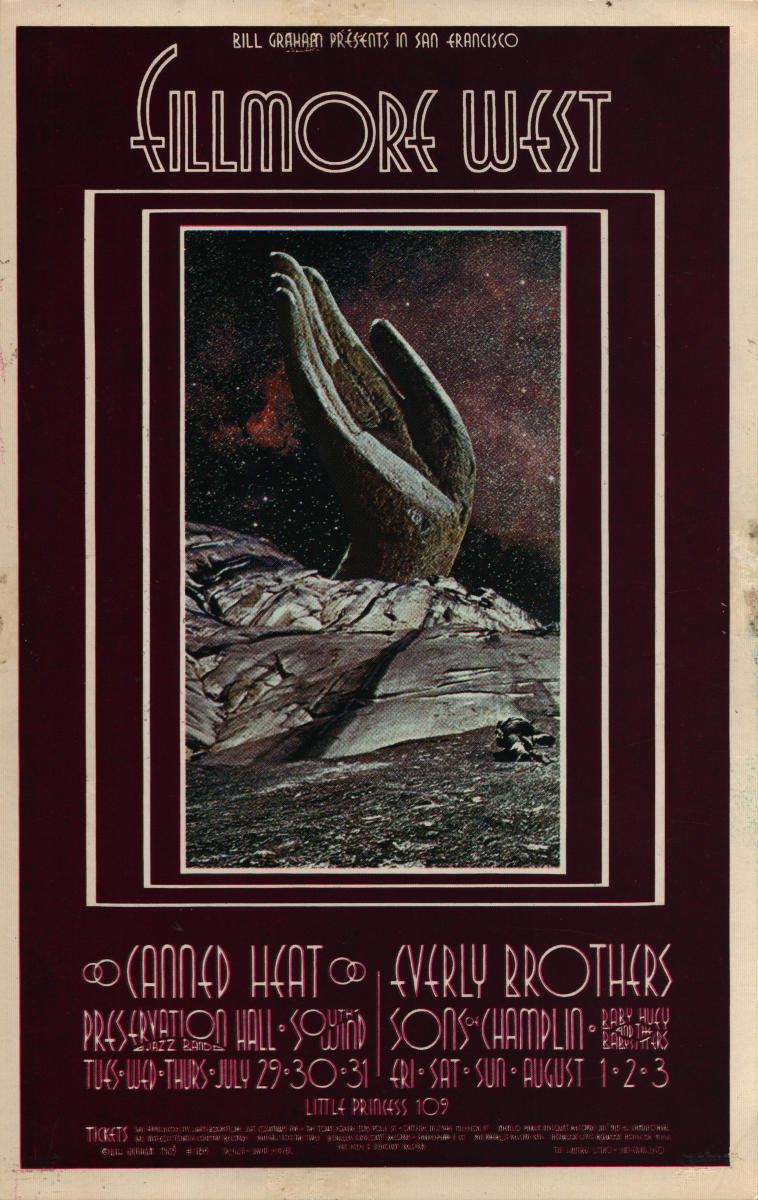
BG-184 · David Singer
San Francisco
Preservation Hall Jazz Band
Southwind
The best story on July 31 comes from the last summer of the ballroom era, and it is a story about a band coming apart on stage. On Thursday, July 31, 1969, the Fillmore West was in the third and final night of a run headlined by Canned Heat, with the Preservation Hall Jazz Band and Southwind below them — an unlikely triple bill of boogie-blues, trad New Orleans jazz, and country-rock, lit by Little Princess #109 (per chickenonaunicycle's Fillmore West list, corroborated on Wolfgang's, which files the run under David Singer's BG-184 poster). Canned Heat were near their commercial peak — "Going Up the Country" had been a hit that spring, and Woodstock, where they would play, was barely two weeks away. But the engagement is remembered less for the boogie than for the exit: this three-night stand is the run during which guitarist Henry Vestine left the band, the friction with bassist Larry Taylor boiling over, with Harvey Mandel brought in to replace him almost immediately afterward. A band does not usually let you watch the seam tear in real time; here the calendar caught it.
David Singer's BG-184 is, like several posters this week, a combined-week sheet — it advertises both the Canned Heat nights (July 29–31) and the following bill, the Everly Brothers with the Sons of Champlin (August 1–3). Singer was by 1969 the house designer for the late Fillmore West posters, working in collage rather than the swirling hand-lettered style of the 1966–67 Fillmore sheets; his BG-184 belongs to the scene's cooler, more graphic final phase. As with the Conklin poster earlier in the week, the printed lineup covers more than any single night held — read it as an advertisement for a week, not a roster for a Thursday.
The other years on July 31 are quieter, and honesty requires saying so plainly rather than filling them. In 1968, the Fillmore West was mid-run: the Butterfield Blues Band, Santana, and Hello People held the stage July 31 as they had July 30, the middle night of the Conklin BG-131 booking — a real show, but the same bill and the same poster already carried by the opening night, so it registers here as continuation rather than event. In 1966 and 1967, July 31 fell on the dark nights the ballrooms left between weekend runs. July 31, 1966 was a Sunday after the Fillmore's Them weekend had closed and before its August bills began; July 31, 1967 was a Monday sitting in the gap between the Avalon's Blue Cheer weekend and its Charles Lloyd weekend, and between the Doors' closing at the Fillmore and Muddy Waters' opening the next night. The one thing chickenonaunicycle lists on either dark night is a Matrix booking — Sandy Bull in 1966, the Youngbloods in 1967 — but each is single-sourced, and the 1967 Youngbloods listing is actively contradicted by the band's own itinerary, which puts their Matrix residency ending weeks earlier and the band itself at the Avalon the weekend before. We record those as doubtful club dates rather than assert them. And 1965, again, predates the scene entirely; the Matrix, the first of these rooms, would not open its doors for another two weeks.
So July 31 is a one-year day, and the year is 1969 — the boogie band at its height and its breaking point on the same stage, under a Singer poster that already had its eye on the decade turning over.
Verification Notes
ANTAGONIST-CHECKED. VERIFIED: 1969-07-31=Thursday; closing night of the Canned Heat / Preservation Hall Jazz Band / Southwind run at the Fillmore West, Jul 29-31, Little Princess #109 lights, David Singer's BG-184 (COAU Fill West + Wolfgang's BG184). This is the run during which Henry Vestine left Canned Heat (Harvey Mandel replaced him). BG-184 is a combined-week sheet also advertising the Everly Bros/Sons of Champlin bill (Aug 1-3). HERO of 07-31.
Were You There?
Do you have memories of this show, or an original BG-184 poster? On This Day in Art Rock History celebrates the people who lived through the psychedelic era. Your stories and collections matter to this archive.
Comments