

Blue Cheer / Captain Beefheart / The Youngbloods (opening)
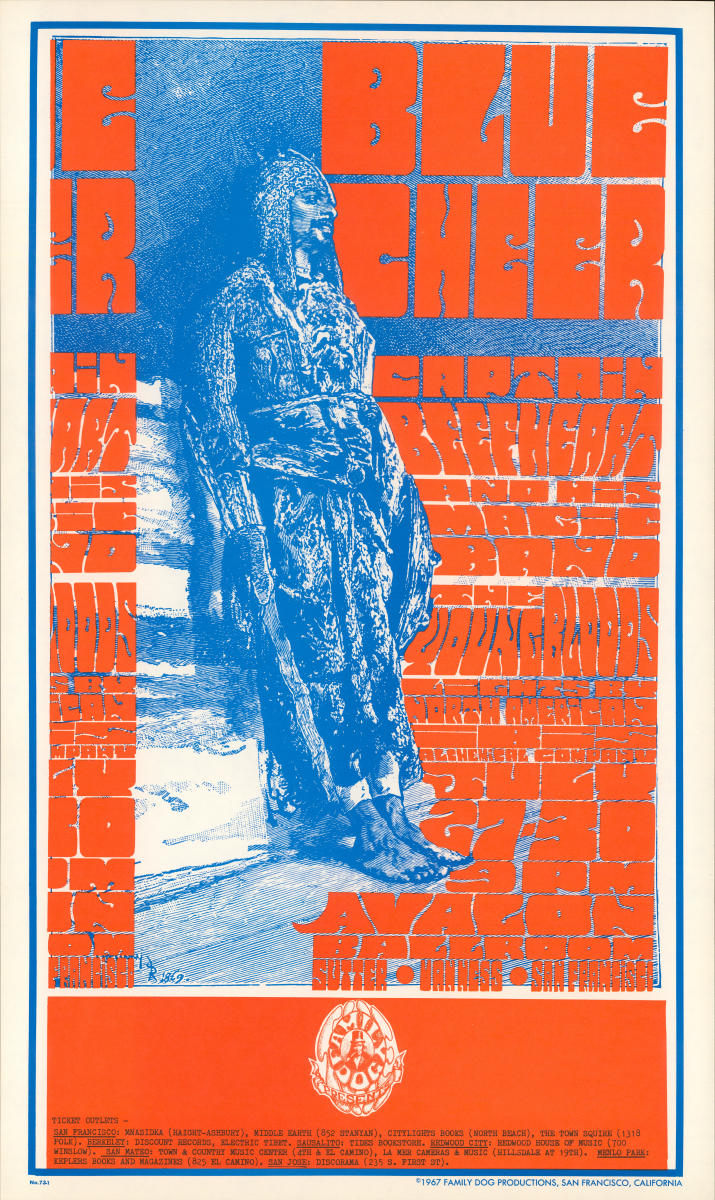
FD-73 · Tom Glass
San Francisco
Captain Beefheart and His Magic Band
The Youngbloods
On July 27, 1967 — a Thursday — the Avalon Ballroom opened a new Family Dog run, and the bill reads today like a dare. Top of the poster: Blue Cheer, the San Francisco power trio. Beneath them: Captain Beefheart and His Magic Band. Beneath them: The Youngbloods. Loud, weird, and gentle, stacked on one Thursday night.
The poster is FD-73, art by Tom Glass, and it is a small joke in itself. Collectors call it the "Smiling Hun" because Glass repurposed a Gustave Doré engraving for the image — a borrowing that was very much in the Family Dog spirit, where old etchings and Victorian type got dragged into the service of a rock show. The run it advertises played July 27–30, 1967 (rockposters.com; ha.com/Heritage lists it as "7/27-30/67"; dking-gallery and authenticvintageposters carry the same poster).
What makes the night worth pausing on is the spread of the bill. Blue Cheer, at the top, were on the cusp of recording *Vincebus Eruptum*, which arrived in early 1968 and carried their pulverizing cover of Eddie Cochran's "Summertime Blues." That record is often cited as a founding document of heavy metal — sometimes as "the first heavy metal album," sometimes as proto-metal or proto-punk. It's worth being honest here: that framing is widely repeated but genuinely contested. Where the line between very loud psychedelic blues and "heavy metal" actually falls is an argument, not a settled fact, and Blue Cheer sit right on the seam of it. What isn't much disputed is that they were extraordinarily, physically loud — that part of the legend has held up better than the taxonomy.
Directly under that wall of volume sat Captain Beefheart, whose *Safe as Milk* was newly out in 1967 — an angular, blues-warped record that pointed toward the far stranger work he'd make later. And under Beefheart, the Youngbloods, whose reading of "Get Together" became one of the era's enduring peace anthems (its biggest chart life came a couple of years on, but the song is inseparable from 1967). So: on a single Avalon stage across those nights you had heavy proto-metal, avant-garde blues, and tender folk-rock — three roads out of the same scene, none of them yet knowing where they led. Bills like this are why the ballroom era resists tidy genre stories. The booking didn't care about the categories we've since imposed.
Cross town the same Thursday, the Fillmore Auditorium was running its own strong bill: The Yardbirds — by now the Jimmy Page–led lineup — with James Cotton and Richie Havens. This was the Yardbirds' third and final night of that stand (the poster is BG-75, Bonnie MacLean's art, already covered on the July 25 page — here it's simply the last night). The very next evening, July 28, the Doors would take that same Fillmore stage. Two of the scene's core ballrooms, two full bills, one weeknight: a genuinely rich Thursday, and a useful reminder that the poster art we collect was documenting an almost nightly abundance.
The other years on this date are quieter, and a couple are worth flagging for the record.
In 1968, July 27 fell on a Saturday, and the Fillmore West was in the middle of a stand headlined by the Charles Lloyd Quartet, with The Herd and — again — James Cotton on the bill (poster BG-130, Lee Conklin). This is the middle night of that second stand.
In 1969, July 27 was a Sunday, and the Fillmore West closed out a run with Steve Miller Band headlining over Albert King and Mountain (poster BG-183, David Singer) — the final night of that stand.
A note on sourcing, since it matters here: some widely-circulated Fillmore West date lists — chickenonaunicycle's among them — run off by one for July 27 in both 1968 and 1969, which is how you end up seeing "Quicksilver / Spooky Tooth" or "Spirit / Lee Michaels" attached to this date. Cross-checked against billgrahamfoundation.org, the correct Saturday-1968 headliner is Charles Lloyd and the correct Sunday-1969 headliner is Steve Miller. I'm going with the foundation's dating.
And to be equally honest about the gaps: on this exact calendar date in 1966 (a Wednesday) and 1965 (a Tuesday), I don't have a documented San Francisco ballroom show — mid-week lulls in 1966, and 1965 predating the scene as we think of it. No show to report isn't the same as a show I've failed to find, but I'll flag it as a gap rather than paper over it.
Still, the anchor holds: an Avalon opening night where the loudest band in San Francisco, one of its strangest, and one of its gentlest shared a single poster — Tom Glass's grinning Doré "Hun" watching over all three.
Verification Notes
ANTAGONIST-CHECKED. VERIFIED: 1967-07-27=Thursday; opening night of the FD-73 'Smiling Hun' run (Tom Glass; repurposed Gustave Doré engraving), Avalon 7/27-30: Blue Cheer / Captain Beefheart / The Youngbloods (rockposters + Heritage '7/27-30/67' + Wolfgang's FD073 'Jul 27 1967'). Blue Cheer 'first heavy metal' framing HEDGED as contested. Hero of 07-27.
Were You There?
Do you have memories of this show, or an original FD-73 poster? On This Day in Art Rock History celebrates the people who lived through the psychedelic era. Your stories and collections matter to this archive.
Comments