

The Youngbloods / Magic Fern / Wildflower (California Hall, Greg Irons)
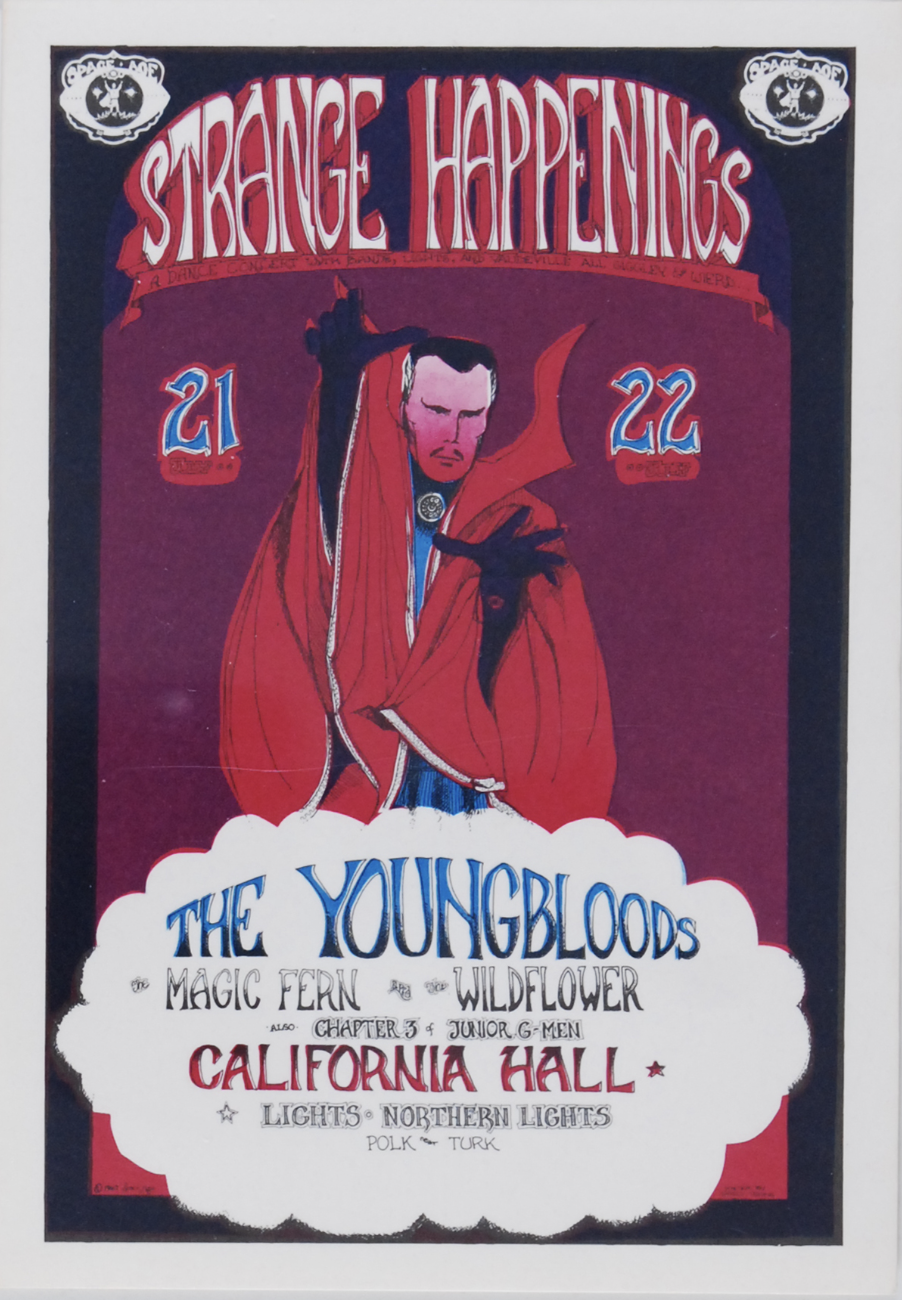
AOR-2.140 · Greg Irons
San Francisco
Wildflower
Magic Fern
On the third Friday of July 1967, while San Francisco's marquee ballrooms drew the tourists and the true believers, a scrappier weirdness set up shop at California Hall, the 1912 Germania-society building at 625 Polk Street, corner of Turk. The bill read like a dare: "Strange Happenings — A Dance Concert with Bands, Lights, and Vaudeville, All Silly & Weird." Above the type loomed a Greg Irons drawing of a caped sorcerer, arms flung upward in a deep-maroon storm — a figure lifted from Marvel's Doctor Strange, the era's favorite mystic. Irons had arrived in the city only that winter, a Philadelphia runaway who'd hand-carried a single printed poster to Bill Graham and talked his way into the trade. In July 1967 he was an unknown on the make, not the underground-comix name he'd become at the decade's turn; this maroon devil is early Irons, and among collectors it survives as one of his scarcest and most coveted images.
Headlining were the Youngbloods, Jesse Colin Young's quartet, caught mid-migration. They were not yet a Marin band — that move came in September; in July they were still working the road, dropping into California Hall between an Avalon stand and a Whisky-a-Go-Go run down south. That very month RCA had issued their single "Get Together," Chet Powers's plea for brotherhood. It stalled at number 62 and vanished. The generational anthem, the gold record, the goosebump-inducing sing-along — all of that belonged to 1969, when a public-service spot resurrected the song. Anyone imagining the California Hall crowd raising voices to "come on people now, smile on your brother" is projecting the future backward. In July 1967 it was just a pretty flop by a band still finding its ground.
Around them orbited names the record leaves faint: Magic Fern and Wildflower, local outfits who played the second-tier halls and left little documentation beyond posters like this one. Honesty demands we not invent them a legend. The evening also promised "Chapter 3 of Junior G-Men" — presumably a serialized film gag or vaudeville turn, the "silly & weird" flavor the poster advertised — and Northern Lights ran the liquid projections. This was an independent production under a "Space"-style logo, outside the Graham and Family Dog machines that defined the scene's official memory.
The contrast is the whole story. That same weekend the big rooms were roaring, and the Avalon hosted Big Brother and the Holding Company with Janis Joplin on FD-72. California Hall was the odd cousin down the block — smaller, cheaper, stranger, trading spectacle for a homemade carnival of lights and vaudeville and a caped magician on the wall. It is exactly the kind of night the standard histories skip: no anthem sung, no legend minted, just a good weird bill in a secondary hall during the Summer of Love, its whole strange spirit now surviving in a single sorcerer's silhouette by an artist nobody yet knew.
Were You There?
Do you have memories of this show, or an original AOR-2.140 poster? On This Day in Art Rock History celebrates the people who lived through the psychedelic era. Your stories and collections matter to this archive.
Comments