

B.B. King / Elvin Bishop Group / Albert Collins (BG-182 first leg)
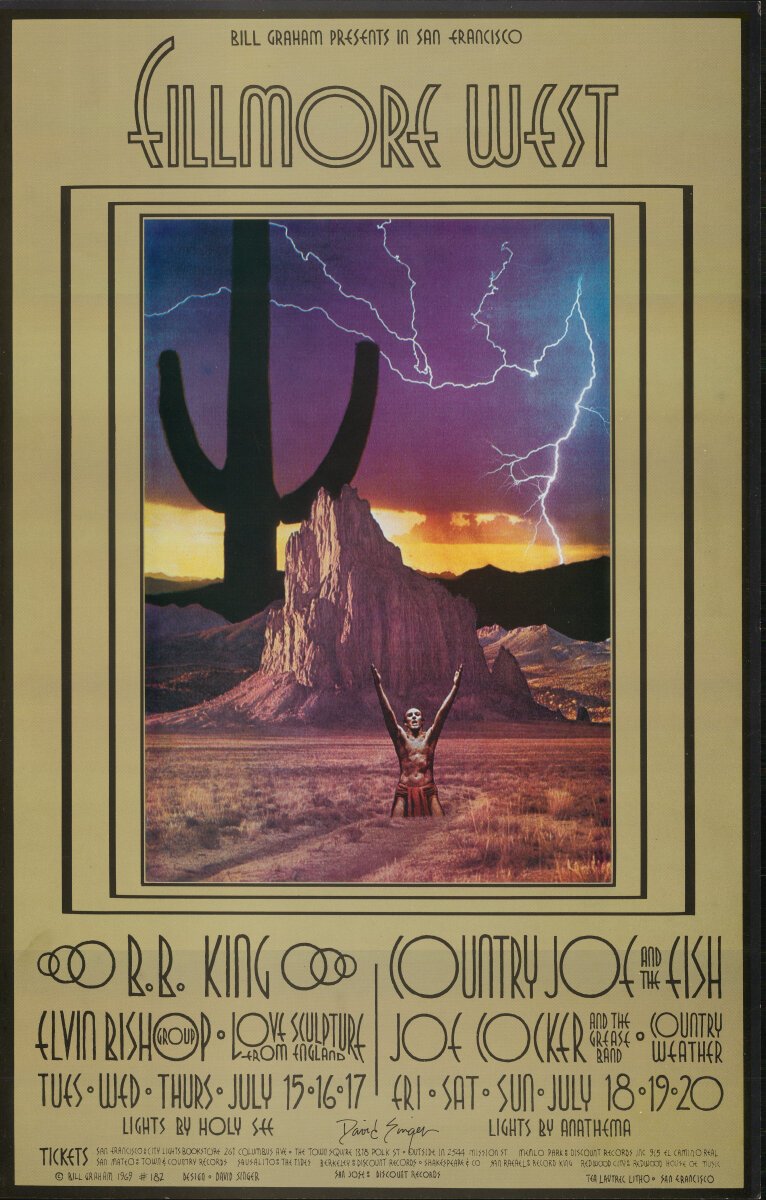
BG-182 · David Singer
San Francisco
Elvin Bishop Group
Albert Collins
On a Thursday night in the third week of July 1969, three generations of the blues shared one stage at Bill Graham's Fillmore West, the converted Carousel Ballroom at Market and Van Ness where a decade of American music was being quietly rewired. The poster, David Singer's BG-182, hung a lightning storm over a kneeling desert figure; it advertised a six-night run, but this first leg belonged to a single lineage of the electric blues. B.B. King headlined, with the Elvin Bishop Group and Albert Collins beneath him, and the arc of the bill told its own story about who was teaching whom.
King was in the middle of the most consequential reinvention of his career. Only two years earlier, in February 1967, Graham had coaxed a hesitant King onto this scene, doubting a room of white hippies wanted his music, and introduced him as "the Chairman of the Board." The crowd rose and stayed risen. King later said the reception left him overwhelmed and a little confused, and that it redirected everything. By July 1969 that redirection was nearly complete: the Rolling Stones would soon carry him across America as their opening act, and just weeks before this Fillmore stand he had cut "The Thrill Is Gone" in a June session. But that record did not yet exist in the world—it would not be released as a single until December—so no one in the room that night could have known they were hearing a man on the cusp of his signature song. What they heard was Lucille and a working bandleader at the peak of his powers, playing for exactly the young audience Graham had built for him.
Beneath King stood Elvin Bishop, the Oklahoma-raised guitarist who had left the Paul Butterfield Blues Band in 1968 and come west to San Francisco. He had signed to Graham's own Fillmore Records, and his debut, the self-titled Elvin Bishop Group, arrived that same year—a record that fused Chicago blues with the country and Southern strains he would ride for the rest of his career. Opening was Albert Collins, "the Iceman," the Texas Telecaster master who fingerpicked in strange open tunings and had only lately been pulled onto the West Coast circuit by the members of Canned Heat. Collins was cutting his Imperial sides in these very months, an unheralded original at the front of a bill he would in time tower over. Lights were by Holy See.
That was the quiet genius of a Graham blues bill: the master, the crossover student, and the raw discovery, stacked in one night so a rock crowd could hear the whole tradition at once. It was ordinary Fillmore business and, in retrospect, something more—Black blues masters carried to young white audiences by a promoter who insisted they belonged there. Woodstock was still a month away, unimagined; the summer had not yet acquired its myth. This was simply a Thursday, three guitarists and their bands, and the ballroom lights turning over the desert on Singer's wall.
Verification Notes
Antagonist pass 2026-07-06: VERIFIED per-night bill (chickenonaunicycle). Weekday Thu OK. BG-182 David Singer is ONE poster spanning July 15-20 1969; first leg (15-17)=B.B. King. Do NOT confuse with BG-183 (following week July 22-27). Internal date-split dealer-text-sourced, image browser-only (gap). Class: core/concert/medium/anchored.
Were You There?
Do you have memories of this show, or an original BG-182 poster? On This Day in Art Rock History celebrates the people who lived through the psychedelic era. Your stories and collections matter to this archive.
Comments