

Quicksilver's Independence Day at the Avalon
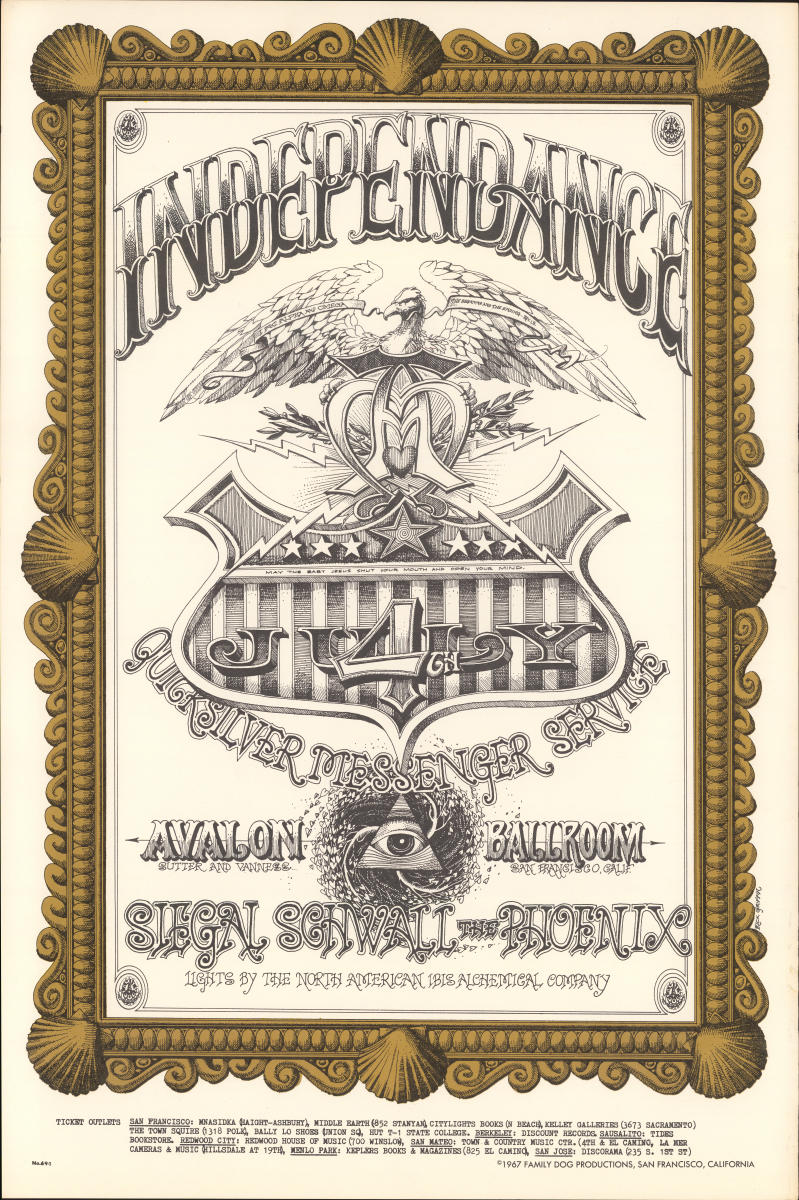
FD-69 · Rick Griffin
San Francisco
On Independence Day 1967, the Avalon Ballroom hung a Rick Griffin poster over its doorway and let the Summer of Love keep burning. The show was billed, with a deliberate misspelling that has followed the poster ever since, "Independance" — Quicksilver Messenger Service headlining, the Siegel-Schwall Band beneath them, and a group called Phoenix at the bottom of the card. It was a single night, July 4th, a Tuesday, and it should not be confused with the multi-night Quicksilver stand that had closed out the same venue only days earlier under a different poster. This was one evening, self-contained, and it caught the San Francisco scene at an almost impossible peak: three weeks after the Monterey International Pop Festival had lifted the local bands into national view, in the neighborhood where the whole thing had been invented.
Quicksilver in July 1967 were the great secret of the ballrooms — a band with no record to their name. Their debut LP for Capitol was still ten months off, arriving in May 1968 behind a cover Griffin himself would draw. So on this night there was nothing to reproduce, nothing a listener could carry home. Everything Quicksilver were, they were only in the room: John Cipollina's guitar with its shivering, church-organ tremolo, the long instrumental architecture the band built out of folk-blues bones, the interplay that made their reputation before a single groove was pressed. To see them on the Fourth was to hear music that existed nowhere else, that would evaporate at the last note. That is the particular romance of album-less Quicksilver, and 1967 is its highest ground.
Griffin, too, was mid-ascent, not yet arrived. He had come up drawing surf cartoons — the character Murphy for Surfer magazine — before he and his wife Ida drifted north to San Francisco in the fall of 1966 to see what the poster scene was about. His first Family Dog poster reached the streets only in March 1967; the "Independance" card came just months into a run that would soon make him one of the form's masters. The imagery that defines Griffin now — the flying eyeball, the Grateful Dead's Aoxomoxoa lettering — was still a year or two ahead of him. What FD-69 shows is an artist reaching for American iconography on an American holiday: the all-seeing eye, the stars-and-stripes shield, an eagle with a banner in its talons, patriotism refracted through psychedelia.
Between the headliner and the newcomer sat Chicago. The Siegel-Schwall Band — Corky Siegel and Jim Schwall, house-trained at Pepper's Lounge on the South Side, recording for Vanguard — brought hard, unhippie blues into the ballroom, a reminder of the tradition all this feedback and light-show reverie was still, at bottom, built on.
Verification Notes
Antagonist-checked. CORRECTED: SINGLE-NIGHT 7/4/67 show, NOT a run (QMS's multi-night stand that window was the separate FD-68, 6/29-7/2, Moscoso poster). VERIFIED: QMS/Siegel-Schwall/Phoenix, Avalon, Family Dog, FD-69 by Rick Griffin; QMS no album until Capitol debut May 1968 (Griffin cover). Synthetic date-key (b). UNABLE-TO-CONFIRM: setlist; which "Phoenix". date high.
Were You There?
Do you have memories of this show, or an original FD-69 poster? On This Day in Art Rock History celebrates the people who lived through the psychedelic era. Your stories and collections matter to this archive.
Comments