Floating Fingers
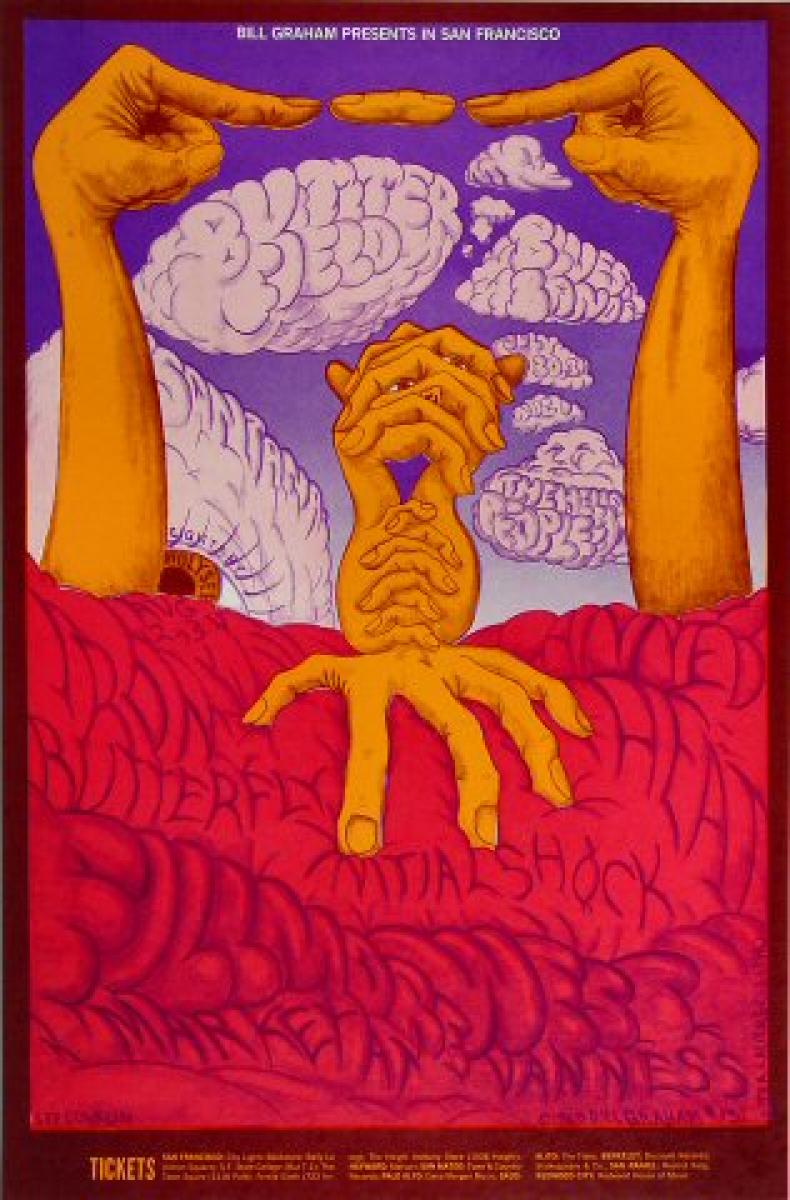
BG-131 · Lee Conklin
San Francisco
Santana
Hello People
On Tuesday, July 30, 1968, Bill Graham opened a six-night stand at the Fillmore West with a bill that reads, in hindsight, like a hinge in San Francisco music: the Paul Butterfield Blues Band headlining, Santana second, and the New York vaudeville-rock act Hello People at the bottom. The Butterfield band was the established draw — Chicago-schooled electric blues with a horn section, the group whose "East-West" had already given the ballrooms a template for the long modal jam. Santana was the local upstart, still months from the debut LP that would make the name a brand, playing the room where they were being built. It is easy now to invert the order in memory; on the night, Butterfield was the star and Santana the openers earning their reputation set by set (per chickenonaunicycle, whose Fillmore West list gives Butterfield / Santana / Hello People for July 30, 31, and August 1, all with Holy See lights).
The poster is the reason this night belongs to July 30 rather than to any of the other five. Lee Conklin's BG-131 is one of the celebrated Fillmore designs — the style where band names hide inside the linework, faces and letters resolving out of what first looks like abstract cloud and landscape. Conklin's poster is also a small trap for the unwary researcher, and worth pausing on, because it is a single sheet advertising two different bills. The engagement ran July 30 through August 4, but the acts rotated at the weekend: Butterfield, Santana, and Hello People held the stage July 30 through August 1, and then Iron Butterfly, Canned Heat, and Initial Shock took over August 2 through 4. All six bands appear on the one poster. Only the first three played this Tuesday. Anyone reading the poster as a single fixed lineup would put Iron Butterfly on a stage they did not reach until three nights later (the July-30 bill and the split are corroborated by chickenonaunicycle's per-night list and by Wolfgang's BG-131 catalog page; the designer credit to Conklin is corroborated on both).
There is a second reason the date matters. This was very early in the Fillmore West's life. Graham had moved his operation into the old Carousel Ballroom at Market and Van Ness only weeks before, in early July 1968, rechristening it the Fillmore West and leaving the original Fillmore Auditorium behind. So July 30 is nearly a housewarming — an established blues band and a rising local one christening a room that would carry the Fillmore name through the turn of the decade. Santana appearing here, this early, in support, is the kind of detail the scene's mythology tends to smooth over: the band that closed Woodstock a year later was, in the summer of 1968, opening for Butterfield on a Tuesday.
The rest of the calendar around July 30 fills in the picture. Across town two years earlier, on July 29 and 30, 1966, the Fillmore Auditorium had hosted Them — Van Morrison's band, near the end of its original run — with the Sons of Champlin in support; that weekend is documented by chickenonaunicycle's Fillmore list and corroborated by Corry Arnold's study of English rock bands at the Fillmore (rockprosopography101), though no reachable catalog confirms a specific BG poster for those two nights, so we leave the poster an open question rather than assert one. In 1967, July 30 was the closing Sunday of the great BG-75 run at the Fillmore Auditorium — the split week where the Yardbirds and then the Doors alternated as headliners over six nights, Bonnie MacLean's poster tying them together; that poster and its opening night already anchor this chronicle earlier in the week, so the Doors' closing Sunday here is a coda rather than a new story. And in 1965 there was simply nothing: the ballroom scene did not yet exist. The Family Dog's first dance was still eleven weeks away, at Longshoremen's Hall in October; the Matrix would not open until mid-August. On July 30, 1965, San Francisco's psychedelic ballroom circuit was a set of empty rooms waiting for a scene that had not been invented.
Which leaves 1968 as the day's center of gravity — an emerging-Santana bill, a Conklin poster that rewards a close look and punishes a careless one, and a newly named ballroom just starting the run it would become famous for.
Verification Notes
ANTAGONIST-CHECKED (2026-07-27). VERIFIED: 1968-07-30=Tuesday; opening night of the split BG-131 (Lee Conklin) run at the Fillmore West -- Butterfield Blues Band / Santana / Hello People, Holy See lights, Jul 30-Aug 1 (COAU Fill West per-night + Wolfgang's BG131). SPLIT-POSTER FIX: the pre-seed bill (Canned Heat/Butterfield/Iron Butterfly/Santana) conflated BOTH legs -- Iron Butterfly/Canned Heat/Initial Shock are the Aug 2-4 leg (logged separately on 08-02/08-04), NOT the Jul 30 bill. Early Fillmore West (opened ~Jul 1968) and an early support-slot Santana. HERO of 07-30 (BG-75 Doors closing this same Sun is secondary -- that poster is already the live hero of 07-25).
Were You There?
Do you have memories of this show, or an original BG-131 poster? On This Day in Art Rock History celebrates the people who lived through the psychedelic era. Your stories and collections matter to this archive.
Comments