Marijuana Defense Benefit
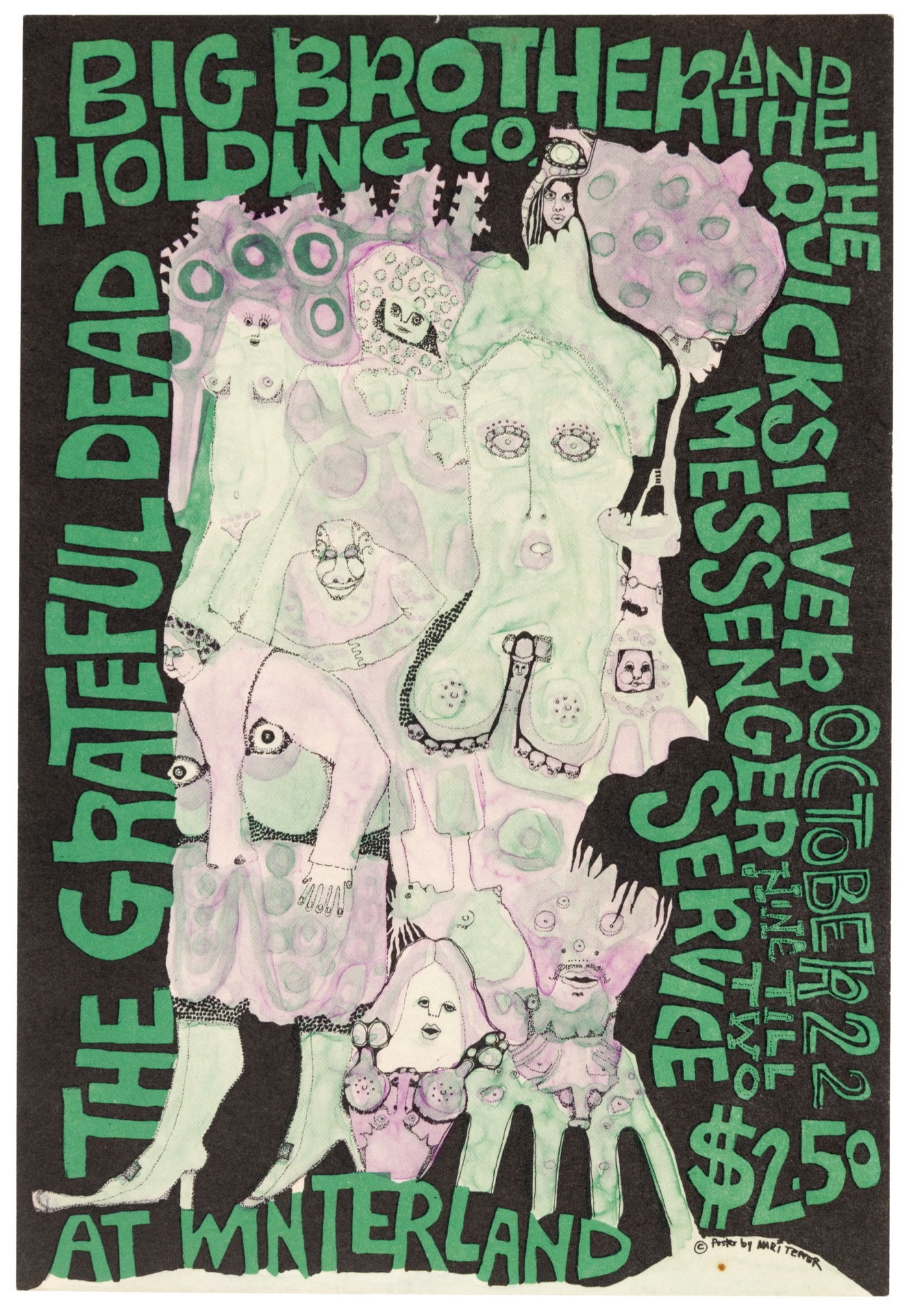
AOR-2.205 · Mari Tepper
San Francisco
Quicksilver Messenger Service
Big Brother and the Holding Company
October 22, 1967 — a Sunday-night benefit at Winterland brought three of San Francisco's biggest bands onto one stage: the Grateful Dead, Quicksilver Messenger Service, and Big Brother and the Holding Company with Janis Joplin. It was billed as a marijuana-defense benefit — a fundraiser for the legal costs the scene was now steadily running up — and its poster is catalogued as AOR 2.205 (Art of Rock, plate 2.205), designed by Mari Tepper (per jerrybase and dead.net for the performance; poster facts via rockposters and the Grateful Dead Archive).
A word first on how this page corrects the record. The Dead's own archive and the poster catalog both date this benefit firmly to **October 22, 1967, a Sunday** — but the chronicle's database row had long carried the wrong date, November 22, 1966 (a Tuesday, and an event no source can document). This run moves the record to its sourced date. The event is the one every reachable source describes: a single-night Winterland benefit, in the autumn of 1967, with the three-band bill above.
The occasion belongs entirely to its moment. The fall of 1967 was the season the Haight's romance curdled into something warier — the "Death of Hippie" mock funeral had been staged that same month — and the community was closing ranks around the practical costs of being a drug culture inside a state that had just criminalized its sacraments. A "marijuana defense" benefit is that instinct made literal: the bands playing to pay the lawyers. The specific defendant the night was raising money for is not pinned by any single source, so this page frames it as what it plainly was — a marijuana legal-defense benefit — without naming a beneficiary it cannot confirm. (It should not be confused with the Haight-Ashbury Legal Organization benefit poster, AOR 2.206, a separate item.)
What makes the night more than a line in a catalog is that the Grateful Dead's set is partly documented — a rarity for 1967. The surviving record (via the Dead's archive and jerrybase) preserves a partial sequence: "Morning Dew," "New Potato Caboose," "It Hurts Me Too," "Cold Rain and Snow," "Turn On Your Lovelight," "Beat It On Down the Line," and a "Cryptical Envelopment → The Other One → Cryptical Envelopment" suite — the band already reaching for the long, through-composed shapes that "Anthem of the Sun" would formalize the next year. A recording of roughly fifty-four minutes exists; the setlist is noted as possibly incomplete. One nice detail of the band's own chronology: Mickey Hart, the second drummer, was most likely not yet aboard this night — his arrival that would lock in the Dead's twin-drummer engine came a little later in the autumn — so this is a near-last glimpse of the single-drummer Dead.
The bill itself is a Monterey Pop reunion in miniature. The Grateful Dead, Quicksilver Messenger Service, and Big Brother and the Holding Company had all played that June festival; four months on, here they were again, stacked on one Winterland benefit. Big Brother's presence is really Janis Joplin's — this is the band with which she had become, overnight at Monterey, the most electric performer the scene had produced, and whose major-label future ("Cheap Thrills," then her exit) was just over the horizon.
The poster is itself a small story. Mari Tepper's AOR 2.205 is a less-famous name than the Wilson / Griffin / Mouse / Kelley axis that dominates the catalog — which is exactly the point: a woman designer in a canon that remembers very few, her sheet earning its place in Paul Grushkin's "Art of Rock" at plate 2.205. (The poster image lives in the classicposters/FAMSF catalog, which a headless pass cannot reach; this day's facts — the date correction, the bill, the designer, the partial Dead setlist — rest on the Dead archive, jerrybase and dead.net, and poster-catalog records rather than on the scan.)
Read plainly, October 22, 1967 is the San Francisco scene doing one of the things it did best: turning its three marquee bands into a single night's fundraiser, four months after Monterey, for the unglamorous business of keeping its people out of jail.
Verification Notes
RESEARCHED+ANTAGONIZED 2026-10-12 (headless). DATE CORRECTION: DB row was mis-dated 1966-11-22 (Tuesday, undocumented in any source) -> corrected to 1967-10-22 (Sunday), the Marijuana Defense Benefit at Winterland. Adjudicated FIX-DB-DATE: GDAO items 239489/239521 + rockposters (Art of Rock plate 2.205, p.193) both date the poster/event to Oct 22 1967; no event documented on 1966-11-22. check-claims OK (jerrybase+deadnet for the performance). Bill: Grateful Dead / Quicksilver Messenger Service / Big Brother & the Holding Company (Janis Joplin). Designer Mari Tepper. Partial Dead setlist survives via GDAO/jerrybase (Morning Dew, New Potato Caboose, It Hurts Me Too, Cold Rain & Snow, Lovelight, BIODTL, Cryptical>Other One>Cryptical; ~54min, possibly incomplete); Mickey Hart likely not yet aboard. HEDGED: the specific marijuana-defense beneficiary is not named by any vetted source -> framed as 'a marijuana legal-defense benefit', no defendant asserted; NOT conflated with AOR-2.206 (HALO benefit). PRE-EXISTING ODDITY for human: 2.205(now 1967-10-22) vs 2.206(1967-05-30) sequence is non-monotonic -- not caused by this fix. Browser-only (classicposters/famsf) for image.
Were You There?
Do you have memories of this show, or an original AOR-2.205 poster? On This Day in Art Rock History celebrates the people who lived through the psychedelic era. Your stories and collections matter to this archive.
Comments